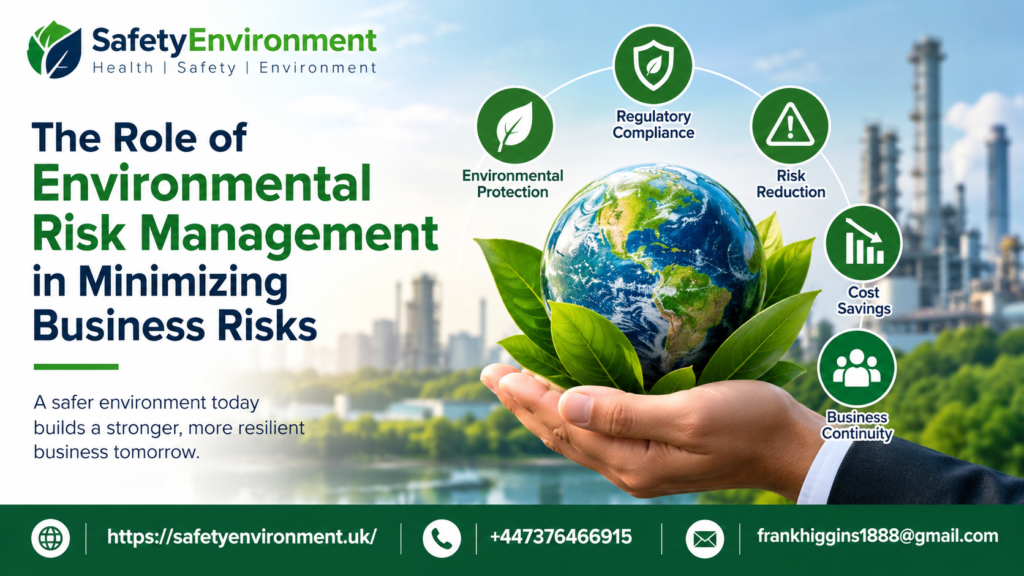
The challenges that businesses face today are more than just financial, operational, and market-related. Environmental issues such as pollution, waste generation, resource depletion, climate-change-related disruptions, and regulatory changes can also present serious risks. Environmental risk management offers a structured way to identify these threats, assess their potential impact, and put in place controls before they become costly business problems.
For UK organizations, environmental responsibilities are increasingly linked to compliance, operational efficiency, sustainability, and stakeholder expectations. A well-designed approach to environmental management can help firms reduce uncertainty, protect their reputation, improve the efficiency of their use of resources, and build increased resilience.
What Is Environmental Risk Management?
Environmental risk management is the process of identifying the environmental hazards and effects of business activities, assessing the probability and severity of these hazards and effects, and implementing suitable controls.
Environmental risks can come from many areas, including:
• Waste storage and disposal
• Chemical spills and leaks
Pollution of air and water
• Energy and water over-consumption
• Dangerous goods
• Noise and Emissions
• Environmental issues in supply chains
• Extreme weather and climate-related events
Failure to comply with environmental regulations
• Lack of emergency preparedness
The target is not to be in a reactive mode in case of an environmental incident. Instead, companies should be proactive in identifying potential problems and taking preventive steps.
An Environmental Management System (EMS), such as an ISO 14001-based system can provide a systematic approach to managing environmental responsibilities, improving performance, and managing environmental risks and opportunities. ISO 14001:2026 places special emphasis on environmental performance, compliance obligations, risk management, and continual improvement.
Environmental risks are business risks
Environmental accidents rarely affect the environment in isolation. They may interfere with normal business operations too.
For example, a chemical spill can result in cleanup costs, regulatory action, production delays, damaged equipment, and reputational consequences. Similarly, poor energy or water use can lead to higher operating costs as well as a greater environmental impact.
This implies that environmental management should be seen as part of the overall business risk management, rather than as a stand-alone sustainability activity.
Good environmental risk management helps organizations think about the direct and indirect consequences of environmental issues. This enables management teams to make better choices and to plan for potential disruptions.How Environmental Risk Management Helps to Reduce Business Risks
1. Helps in Early Detection of Environmental Hazards
The biggest benefit of environmental risk management is early identification.
Businesses can look at their activities, processes, materials, equipment, and facilities to see where environmental incidents may occur. Once the risks are identified, they can be prioritized based on their likelihood and impact.
By identifying problems early, businesses have the chance to put controls in place before the problem turns into an expensive incident.
Routine inspection of chemical storage areas can detect damaged containers, inadequate labeling, or poor containment before a leak occurs.
2. Aids in Environmental Regulatory Compliance
Environmental regulations can be complex and vary depending on the industry, location, and type of operation. If a business does not understand the requirements that apply to it, it may face enforcement action, financial penalties, restrictions on its activities, or damage to its reputation.
An environmental management process will enable businesses to identify their relevant compliance obligations and monitor whether controls are still effective.
Explaining ISO, it states, “An environmental management system can assist organizations to meet applicable environmental requirements and improve environmental performance over time.
Businesses should periodically review relevant legislation, permits, procedures, monitoring requirements, and reporting responsibilities.
3. Less Risk of Costly Environmental Incidents
Environmental incidents are costly. Costs can be: emergency response, waste disposal, environmental investigations, repairs to equipment, legal expenses, remediation, business interruption.
Environmental Risk Management is about prevention, not just dealing with the consequences.
Risk assessments, inspections, maintenance programs, spill-response procedures, staff training, and emergency plans can all help minimize the likelihood and severity of environmental incidents.
Thus, a proactive approach can be an insurance for the environment and the financial performance of the organization.
4. Increases Efficiency of Resources
Poor use of resources often goes along with environmental risks.
Excessive use of electricity, fuel, water, raw materials or packaging may increase operating costs and increase environmental impacts.
Environmental management encourages organizations to measure their consumption and look for opportunities to improve.
Common initiatives include:
• Reduction in energy use
• Water efficiency upgrades
• Reducing waste of material
• Increasing recycling and re-use
• Manufacturing process optimization
• Minimizing excess packaging
• Improving waste segregation. ISO details the benefits of effective environmental management, such as resource efficiency, waste reduction, and improved operational performance.
5. Safeguards Business Reputation
More and more customers, employees, investors, suppliers and local communities are demanding that businesses behave responsibly toward the environment.
A major environmental disaster can shatter customer trust and damage a company’s image. Even if an incident does not result in significant environmental damage, a lack of good communication or response can generate negative perceptions.
A good environmental management system shows that an organization is serious about its environmental responsibilities.
Good stakeholder confidence can be built through clear policies, employee awareness, well-documented procedures, monitoring, and open reporting of performance.
6. Enhances Business Continuity
Climate-related events and environmental incidents can impact operations.
Flooding, extreme weather, pollution incidents, supply-chain disruption, water shortages and energy-related challenges could impact production, transportation, facilities and suppliers.
Environmental risk assessments can help organizations to identify vulnerabilities and develop contingency measures.
Businesses may consider alternative suppliers, emergency response arrangements, backup resources, equipment protection, communication procedures, and recovery plans.
This makes environmental management an essential element of wider organizational resilience.
Key Aspects of a Successful Environmental Risk Management Process
A practical way may be to follow several stages.
Environmental elements identification
Learn about the relationship between business and the environment. This can include emissions, waste, energy use, water consumption, chemicals, transport and raw materials.
Risk Assessment
Assess the probability and possible effects of each environmental risk. Higher-priority risks should be subject to greater attention and tighter controls.
Controls Apply
Implement appropriate measures to prevent or mitigate risks. Controls may be engineering solutions, procedures, training, monitoring, maintenance or emergency arrangements.
Tracks progress
Determine whether controls are working effectively by using inspections, audits, measurements, incident records, and environmental indicators.
Review and Revise
Environmental risks can change as companies add new equipment, processes, suppliers, products or facilities. Regular reviews ensure controls remain relevant.
This process of continuous improvement is compatible with the framework of contemporary environmental management systems. ISO defines the EMS approach as a process of planning, implementation, evaluation, management review and continual improvement.
ISO 14001 and Environmental Risk Management
ISO 14001 is an international standard for Environmental Management Systems. The present edition, ISO 14001:2026, provides a framework for organizations to manage systematically their environmental responsibilities.
It covers such areas as environmental performance, compliance obligations, environmental objectives, risk and opportunity management, resource efficiency and continual improvement.
An EMS can bring benefits even without certification. The principles of ISO 14001 can also be used by businesses to improve their internal environmental processes .
If successfully implemented, an EMS can also be integrated with other management systems, such as quality and occupational health and safety systems.
Workplace Risk Assessment and Environmental Risk Management
Environmental and occupational hazards are often combined. For instance, a chemical spill may present an environmental hazard as well as a health and safety hazard for employees.
Therefore, businesses should not deal with environmental management and workplace risk assessment as separate and distinct activities.
An integrated approach can help organizations to identify risks that may affect employees, the environment, property, operations and the wider community.
This approach can bring consistency and make risk management part of everyday business decision making.
Practical Steps for Businesses
Practical steps to begin with strengthening Environmental Risk Management for your business include:
1. Create an environmental policy suitable for the organization.
2. Identify key environmental aspects and risks.
3. Examine applicable environmental legislation and obligations.
4. Set measurable environmental objectives.
5. Train employees on the environmental responsibilities.
6. Develop procedures for waste, chemicals, spills, emissions and use of resources.
7. Perform routine inspections and internal audits.
8. Track environmental performance using quantifiable indicators.
9. Develop and test emergency response procedures.
10. Review performance regularly and take corrective actions.
The approach should be appropriate to the size, activities, environmental impacts and level of risk of the organization.
Summary.
Environmental issues can have serious financial, legal, operational and reputational consequences for businesses. Environmental Risk Management helps organizations move from reactive problem solving to proactive risk prevention.
By identifying environmental hazards, improving compliance, reducing waste, optimizing resources, preparing for emergencies and continually reviewing performance, businesses can reduce their exposure to environmental and operational risks.
A structured Environmental Management System that links environmental responsibilities with day-to-day business processes may provide further support. ISO 14001:2026 offers a recognized framework for organizations seeking a system to address environmental performance, compliance, risk management and continual improvement.
Good Environmental Risk Management is more than simply protecting the environment in the end. It can also assist businesses to become more resilient, efficient, compliant and prepared for future challenges.
Frequently Asked Questions
1. What does environmental risk management mean?
Environmental Risk Management is the recognition, appraisal, management and surveillance of environmental risks resulting from business operations. The tool helps organizations to prevent pollution, reduce incidents, improve compliance and protect business operations.
2. Why is Environmental Risk Management important to business?
Environmental Risk Management helps businesses avoid the risk of environmental incidents, regulatory problems, operational disruption, unnecessary costs and reputational damage. It also promotes resource efficiency and long-term business resilience.
3. ISO 14001 & Environmental Risk Management: How Can It Help?
ISO 14001 provides a structured approach to the development of an Environmental Management System. Enables organizations to systematically identify environmental aspects, manage risks and opportunities, meet applicable obligations, set objectives and targets, monitor performance and continually improve their environmental management processes.
4. What are the usual environmental business risks?
Common hazards are chemical spills and releases, pollution, poor waste disposal, overuse of resources such as water or energy, accidents involving dangerous materials, non-compliance with laws and regulations, extreme weather events and supply chain environmental impacts.
5. How does environmental risk management reduce business costs?
Yes, I am. Good environmental management can improve energy and water efficiency, reduce waste and incidents, and improve operational processes, all of which can reduce costs. ISO lists benefits of a good EMS as including cost savings and operational efficiency.
6. How often should environmental risks be reviewed?
Environmental risks should be reviewed periodically and whenever there are significant changes to processes, equipment, materials, suppliers, legislation, facilities or business activities. By regularly monitoring and reviewing to ensure controls are still effective as risks change.