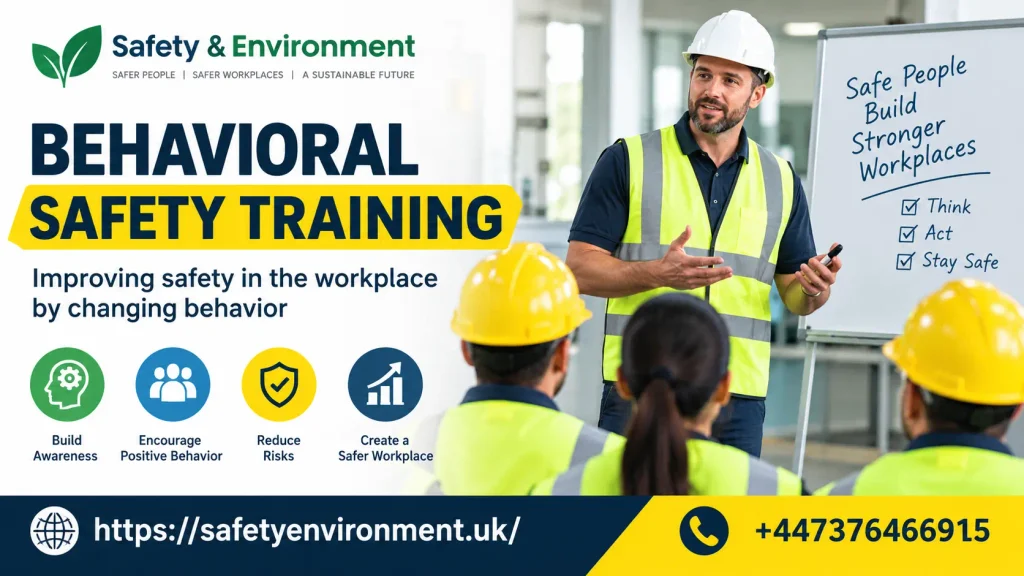
Risk assessments and protective equipment, more than written procedures, affect workplace safety. How people behave when they do their everyday tasks can also make a big difference to health and safety performance. Employees may know the rules but still take shortcuts, overlook hazards, fail to report near misses, or become accustomed to unsafe practices.
This is where behavioral safety training can be of great value. It’s about recognizing workplace behaviors, understanding why people behave in certain ways, and encouraging safer working practices through observation, communication, feedback, and employee involvement.
The UK Health and Safety Executive (HSE) says behavior, leadership, worker engagement, and organizational culture are key elements of improving safety in the workplace. HSE also states that human factors include environmental, organizational, job, and individual factors, which can influence behavior at work.
What is Behavioral Safety Training?
Behavioral safety training is a workplace safety approach that focuses on the behaviors of employees and managers while they are working.
Traditional safety training is often based on rules, procedures, legislation, equipment, and hazards. Behavioral safety takes this a step beyond by asking questions such as
• Are workers following safe working procedures?
• Why are we making unsafe shortcuts?
• Do workers feel free to report hazards?
• Are supervisors modeling safe behavior?
• Are employees proactively spotting potential risks?
• Are the safety procedures practical and easy to follow?
A behavioral safety program might define safe and unsafe behaviors, observe on-the-job practices, and provide feedback and reinforcement for safer behaviors. HSE says these are typical elements of behavioral safety approaches.
Why Does Workplace Behavior Matter?
If you don’t understand it or practice it, then it’s not a safety procedure. Written policies may not provide the protection sought if employees routinely ignore procedures, take shortcuts, or fail to communicate hazards.
But it is essential to keep in mind that unsafe behavior is not just an individual issue. HSE guidance stresses that organizational factors may have a major impact on behavior. These include workload, work design, resources, communication, leadership, and workplace culture.
Therefore, effective behavioral safety should look at more than just the individual’s actions; it should also look at the work environment that influences those actions.
Benefits of Behavioral Safety Training
A structured behavioral safety training program can help organizations generate greater awareness of workplace risks and encourage employees to be more proactive in safety.
1. Better Hazard Awareness
Training helps employees to identify unsafe conditions and behavior before they are part of an incident.
“Rather than reacting following an accident, workers can be trained to identify hazards in their daily activities and voice concerns earlier.
2. Improved Safety Communication
Open communication is a part of a positive safety culture. Encourage employees to talk about hazards, near misses, and practical safety issues.
HSE’s approach to safety climate includes things like trust, employee engagement, health and safety focused behaviors, and near-miss reporting.
3. Greater employee engagement
The health and safety department cannot be the only department responsible for health and safety. Employees, supervisors, and managers all have an impact on behavior in the workplace.
Employees who take part in observations, discussions, and improvement activities can contribute practical knowledge on the tasks they perform on a daily basis.
4. Enhanced Safety Culture
A positive safety culture is more than just policies on the wall. It reflects the attitudes, values, behaviors, and management practices that affect the way work is actually done.
HSE defines safety culture as “the combination of attitudes, values, behaviors, and management systems that determine how things are done in an organization.”
How Behavioral Safety Training Affects Behavior in the Workplace
Typically, behavior change does not occur through a single training session. It needs constant reinforcement and involvement throughout the organization.
Step 1: Determine Critical Behaviors
The first step is to identify the behaviors that are most associated with workplace risk.
These might include, depending on the industry:
• Proper use of PPE
• Manual handling safety
• Compliance with permit-to-work procedures
• Lockout/tagout procedures
• Work safely at height
• Proper use of machinery
• Vehicle transit secured
• Housekeeping.
• Reporting of hazards and near misses
The behaviors selected should be relevant to the real risks employees are exposed to.
Step 2: Find out how the workplace works
Observation can help organizations to understand how procedures are being followed in real work conditions.
The goal should not be to catch employees doing something wrong. Instead, observations can be used to identify barriers, understand why certain behaviors occur, and to encourage safer alternatives.
Step 3: Deliver Positive Feedback
Providing feedback is an important part of behavior change.
Seeing a safe behavior can be reinforced with positive feedback. If an unsafe behavior is observed, the conversation should revolve around the risk, why the behavior happened, and how it can be done in a safer way.
This provides an opportunity for learning rather than merely blaming.
Step 4: Identify Root Causes
Where employees are repeatedly doing a task in an unsafe way, organizations should investigate why.
Possible causes include:
• Poorly designed processes
• Too high workload
• Insufficient equipment
• Insufficient training
• Pressure to deliver
• Poor communication
• Absence of supervision
• Unclear roles
• Unsuitable work schedules
HSE’s human factors guidance emphasizes that behavior is determined by the interaction between the individual, the job, and the organization.
Safety Culture and Behavior-Based Safety
Behavioral safety and safety culture are closely related, but are not the same.
Behavioral safety is about specific actions and behaviors; safety culture is about the wider environment in which those behaviors happen.
For example, part of the picture is asking employees to follow a safe procedure. Management also needs to make sure that employees have the time, resources, equipment, and support to follow that procedure.
HSE warns that behavior-based intervention cannot compensate for issues such as poor staffing, poor shift patterns, lack of process training, or production pressures.
Therefore, behavioral safety training should be integrated into a wider health and safety management system rather than treated as a standalone solution.
Managers’ and supervisors role
Managers and supervisors can have a huge effect on the behavior of the workplace.
Employees tend to follow what they see their supervisors do, not what the company policies tell them to do. Managers can reinforce the organization’s safety expectations by modeling safe practices consistently, discussing hazards, and responding appropriately to safety concerns.
Management commitment, employee involvement, communication, and intervention planning are identified as important components of safety culture enhancement in HSE’s safety culture training.
Managers can foster behavioral safety by:
• Leading the way •
• Speaking about safety in team meetings
• Fostering hazard reporting
• Responding to employee concerns
• Positive safety behaviors
• Checking for near misses
• Making real safety improvements possible
Who Needs to Take Behavioral Safety Training?
Behavioral safety training can be used in many industries where risk is affected by human behavior and conditions in the workplace.
It is especially useful for:
• Construction firms
• Manufacturing companies
• Warehousing & logistics
• Engineering organizations
• Utilities
• Gas and petroleum
• Facility management
• Operations of transport
• Health care institutions
• Energy and industrial companies
The training can be tailored to the organization’s hazards, workforce, operational procedures, and safety objectives.
Measuring Effectiveness of Behavioral Safety
Organizations should use appropriate indicators to establish whether their safety initiatives are delivering meaningful improvements.
Potential measures are as follows:
• Safety observations performed
• Reportable incidents
• Incident reports
• Employee involvement
• Implemented Corrective Actions
• Toolbox talks
• Attendance at training
• Following critical safety procedures
• Findings of inspection and audit
It is useful to mix leading indicators like observations and hazard reporting with lagging indicators such as accident and injury data.
The HSE Safety Climate Tool also includes measures relating to areas such as organizational commitment, safety behaviors, trust, usability of procedures, engagement, resources and reporting of near-misses.
Blunders to avoid
A behavioral safety program can be ineffective if the focus is only on employee mistakes.
Do not:
The Blame Game
If it happens repeatedly, it may indicate a wider organizational or task-related issue.
Focusing Just on Accident Numbers
But a drop in reported incidents doesn’t necessarily mean increased safety. For example, fewer reports may be a result of reduced reporting rather than fewer hazards.
Disregarding Employee Input
Those who do the work each day often see practical problems that are not obvious from written procedures.
Training as a One-Time Event
You need reinforcement, communication, leadership, and continuous improvement to change behavior.
Concluding Thoughts
Behavioral safety training can help organizations to look beyond the written procedures and understand how people really work in real situations.
The best way is the combination of employee engagement, leadership, observation, feedback, hazard awareness, and improvements to the systems and conditions that impact behavior. It shouldn’t be used to blame workers for unsafe behaviors.
“A strong workplace safety culture develops when employees and managers share responsibility for identifying risks, communicating concerns, and supporting safe working practices.
Behavioral safety can be integrated with risk management, human factors, leadership, and workplace safety training to provide a more holistic health and safety management approach for organizations that want to improve their safety culture. HSE also stresses that behavioral change and worker involvement should be part of the wider system of health and safety management.
FREQUENTLY ASKED QUESTIONS
1. What Does Behavior Safety Training Mean?
Behavioral safety training is about behaviors in the workplace that can impact health and safety. It helps employees and managers to know safe and unsafe practices, understand the factors that influence behavior, and promote safer ways of working.
2. Why is behavioral safety important in the workplace?
Behavioral safety can enhance hazard awareness, communication, employee engagement, and safety practices. It also enables organizations to examine the reasons why people do unsafe things, not just the behavior itself.
3. Is behavioral safety training industry-specific?
It can be adapted for a multitude of industries, including construction, manufacturing, logistics, engineering, energy, transport, and facilities management. Training should be commensurate with the specific hazards and working conditions in the organization.
4. What is included in behavioral safety training?
Subjects can include safety culture, human factors, safe and unsafe behaviors, hazard awareness, observation techniques, feedback, near-miss reporting, employee engagement, safety leadership, and behavior change.
5. How does behavior safety improve safety culture?
It can encourage employees to participate in safety, discuss hazards, and reinforce safe work practices. However, behavioral safety has to be supported by appropriate management systems, resources, procedures, and leadership.
6. Can behavioral safety be used instead of traditional health and safety training?
No. Behavioral safety is an addition, not a replacement, for traditional health and safety controls and training. This is still relevant where organizations need appropriate risk assessments, procedures, competence, equipment, and other controls relevant to their workplace risks.