Safety Compliance Audits UK
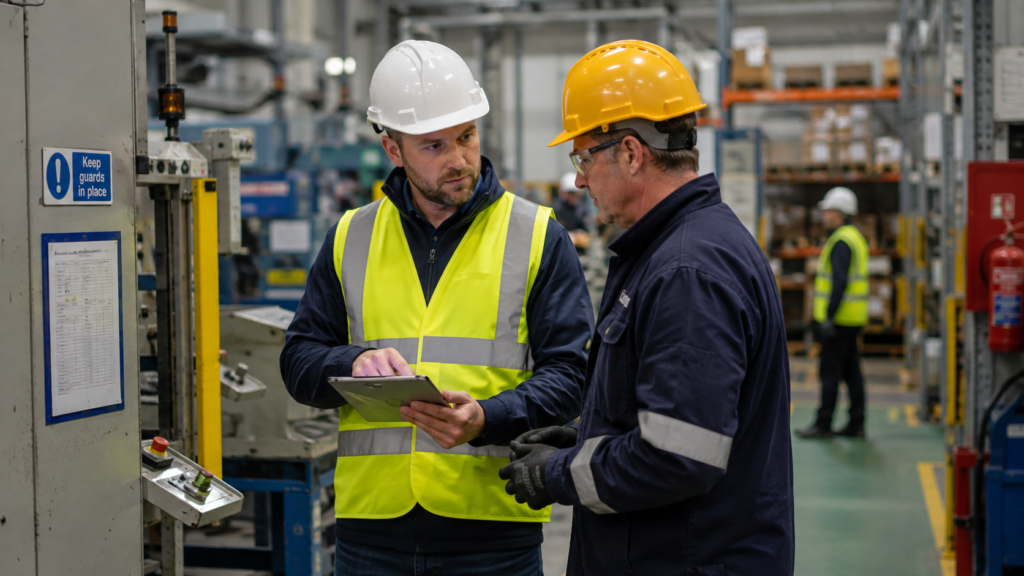
Professional Safety Compliance Audits for UK Businesses
A safety compliance audit gives your organisation an independent, structured review of how well your health and safety arrangements are working in practice — not just on paper. It’s designed for employers, directors, facilities managers, H&S managers and site managers who want a clear picture of where their current arrangements stand, what’s working well, and where improvement is genuinely needed.
SafetyEnvironment.uk carries out safety compliance audits for UK businesses across construction, manufacturing, warehousing, facilities management and other sectors. Rather than simply checking whether documents exist, we look at whether your safety arrangements are actually implemented, understood and followed on the ground — because that gap between documented policy and day-to-day practice is where most weaknesses are found.
An independent review can be valuable even for organisations that already manage health and safety well, since it brings a fresh, external perspective that internal reviews can sometimes miss.
Request a Safety Compliance Audit
What Is a Safety Compliance Audit?
A safety compliance audit is a structured review of an organisation’s health and safety arrangements, assessed against applicable legal duties and recognised good practice. Depending on the agreed scope, this can include:
- health and safety policies and management arrangements
- risk assessments and how they reflect actual work activities
- control measures and whether they’re implemented consistently
- training and competence records
- workplace conditions and equipment
- inspection and maintenance arrangements
- emergency procedures
- incident and accident reporting
- monitoring and review processes
- management responsibilities and oversight
The scope of an audit should be tailored to the organisation, its activities and its risk profile — a warehouse operation and a professional office have very different audit priorities, and a good audit reflects that rather than working through a generic checklist.
Why Are Safety Compliance Audits Important?
Health and safety documentation can look complete on paper while day-to-day practice tells a different story. A compliance audit is a practical way to check whether that gap exists, and where. Common reasons organisations commission an audit include:
- Identifying compliance gaps before they become a bigger issue
- Detecting weaknesses that internal reviews may not pick up
- Verifying implementation — checking that documented procedures are actually followed
- Improving management systems based on real findings, not assumptions
- Identifying documentation gaps, such as outdated risk assessments or missing records
- Reviewing the effectiveness of existing controls
- Prioritising corrective actions so limited time and budget go where they matter most
- Supporting continual improvement across the organisation
- Giving management clearer oversight of the organisation’s actual safety position
A safety compliance audit doesn’t guarantee that incidents won’t happen or that a business is automatically compliant — no audit can promise that. What it provides is a clearer, evidence-based understanding of your current position and practical priorities for improvement.
What Does a Safety Compliance Audit Cover?
Health and Safety Policy
Reviewing whether the organisation has appropriate policy arrangements in place and whether responsibilities for health and safety are clearly defined and understood.
Risk Assessments
Checking whether relevant workplace risks have been identified, whether the assessments reflect how work is actually carried out, and whether the resulting controls are appropriate and implemented.
Safe Systems of Work
Assessing procedures and working arrangements for higher-risk activities, and whether they’re followed consistently in practice.
Training and Competence
Reviewing relevant training records, competency arrangements, induction processes and refresher training where applicable to the role and activity.
Workplace Conditions
Considering housekeeping, access and egress, lighting, welfare facilities and other conditions relevant to the workplace.
Work Equipment
Reviewing inspection, maintenance and safe-use arrangements for relevant work equipment.
Hazardous Substances
Considering COSHH arrangements and controls where the organisation uses or stores hazardous substances.
Personal Protective Equipment
Reviewing PPE selection, provision, use, maintenance and management arrangements where relevant.
Emergency Arrangements
Considering emergency procedures, communication arrangements, evacuation planning and incident response.
Accident and Incident Management
Reviewing reporting arrangements, investigation processes and how lessons are captured and acted on.
Contractor Management
Assessing how contractors and third parties are selected, managed and monitored, where relevant to the organisation’s activities.
Monitoring and Review
Assessing whether health and safety performance is actively monitored and reviewed, rather than assumed.
The specific areas covered depend on your organisation’s activities, risk profile and agreed audit scope — not every audit needs to cover every area listed above.
Our Safety Compliance Audit Process
- Initial Consultation We start by understanding your organisation, workplace, activities, workforce and risk profile, along with what you want the audit to achieve.
- Define the Audit Scope We agree which areas, locations, activities and documentation will be reviewed, so the audit is proportionate and relevant to your organisation.
- Documentation Review We review relevant policies, risk assessments, method statements, procedures, training records, inspection records, maintenance documentation and incident records.
- Workplace / Site Assessment Where appropriate, we assess actual workplace conditions and check whether documented safety arrangements are genuinely implemented on the ground.
- Compliance and Gap Assessment We identify strengths, weaknesses, gaps and areas requiring improvement, including any potentially significant findings.
- Risk-Based Prioritisation Findings are prioritised according to their significance and urgency, so you know what to address first.
- Audit Report You receive a clear report setting out findings, supporting evidence and observations, areas of concern, and practical recommendations with suggested priorities.
- Corrective Action Support Where agreed, we can support the implementation of recommendations and review progress against them.
What Can a Safety Compliance Audit Identify?
Depending on the scope and your organisation’s circumstances, a compliance audit can help identify issues such as:
- Missing or outdated risk assessments
- Inadequate or inconsistent control measures
- Weak or incomplete documentation
- Inconsistent implementation of procedures across sites or teams
- Gaps in training or competence records
- Gaps in inspection or maintenance arrangements
- Weaknesses in work equipment management
- Inadequate contractor controls
- Gaps in emergency preparedness
- Poor incident investigation arrangements
- Inadequate monitoring of safety performance
- Workplace hazards not previously identified
- Inconsistent safety procedures between departments or locations
The specific findings will always depend on your organisation, activities and the agreed audit scope — no two audits produce identical results.
Who Should Consider a Safety Compliance Audit?
Safety compliance audits are relevant to a wide range of UK organisations, including:
- Small and medium-sized businesses
- Larger organisations with more complex operations
- Construction companies
- Manufacturing businesses
- Warehousing and logistics operators
- Facilities management organisations
- Offices and commercial premises
- Engineering businesses
- Retail operations
- Hospitality businesses
- Contractors
- Organisations operating across multiple sites
Legal duties and appropriate audit scope vary between organisations depending on their industry, activities, workplace and level of risk — a compliance audit is tailored accordingly rather than applying a one-size-fits-all approach.
When Should a Safety Compliance Audit Be Carried Out?
There’s no single mandatory audit frequency that applies to every UK business — the right timing depends on your sector, risk profile and any sector-specific requirements that may apply to you. Common circumstances where organisations commission an audit include:
- Establishing a new health and safety management system
- As part of a periodic management review
- Following significant changes to operations
- After introducing new equipment or processes
- Expansion into new premises
- Significant organisational or structural changes
- Following an incident
- Following repeated safety concerns being raised
- Ahead of, or during, supplier or contractor reviews
- Preparing for external certification or assessment
- Reviewing progress on previous corrective actions
- Where management simply wants an independent, up-to-date assessment
Internal vs Independent Safety Compliance Audits
Internal Audit Conducted by competent people within the organisation.
Potential advantages: familiarity with day-to-day operations, existing internal knowledge, and the ability to support ongoing monitoring.
Potential limitation: reduced independence, since internal auditors may be more likely to overlook issues they’re closely involved with.
Independent Audit Conducted by an external, competent consultant such as SafetyEnvironment.uk.
Potential benefits: an independent perspective, external expertise, identification of weaknesses that internal teams may not notice, objective recommendations, and additional assurance for management, directors or stakeholders.
Both approaches have a role to play — many organisations use internal reviews for ongoing monitoring and commission an independent audit periodically for a fresh, external assessment.
Safety Compliance Audit vs Safety Inspection vs Risk Assessment
These terms are often used loosely, but they describe different activities:
Activity | Main Purpose | Typical Scope | Typical Outcome |
|---|---|---|---|
Safety Inspection | Check current workplace conditions or specific hazards | Focused — a particular area, activity or piece of equipment | Immediate observations and corrective actions |
Risk Assessment | Identify hazards, who may be harmed, and required controls | Specific activity, task or process | Documented risks and control measures |
Safety Compliance Audit | Systematically review whether safety management arrangements meet legal duties and good practice | Broad — policies, procedures, documentation, training, implementation | Structured report with prioritised findings and recommendations |
None of these activities replaces the others — a mature health and safety management approach typically uses all three, at different points and for different purposes.
UK Health and Safety Compliance
UK businesses are expected to manage health and safety risks in line with the legal duties applicable to their specific activities. What applies to a particular organisation depends on factors including their industry, work activities, workplace, number of employees, equipment used, hazardous substances involved, and overall level of risk.
Relevant considerations commonly include health and safety legislation, risk assessment, management arrangements, access to competent advice, employee consultation, training, monitoring, review and continual improvement.
An audit can help identify areas where an organisation’s arrangements may need improvement — it does not itself create legal compliance. Genuine compliance depends on how an organisation acts on its findings and maintains its arrangements over time.
Benefits of Professional Safety Compliance Audits
- An independent, external perspective on your current arrangements
- Better visibility of compliance gaps that internal reviews may miss
- Improved understanding of risk across your organisation
- More consistent safety arrangements across sites or departments
- Better-organised, more complete documentation
- Clear, prioritised corrective actions
- Improved oversight for management and directors
- Practical support for continual improvement
- A stronger foundation for building or maintaining a positive safety culture
Why Choose SafetyEnvironment.uk?
- UK-focused consultancy — our audits are built around UK health and safety duties and how they apply to different industries and activities.
- Practical, evidence-based approach — we look at how safety arrangements actually operate on site, not just whether documents exist.
- Bespoke audit scope — every audit is tailored to your organisation’s activities and risk profile rather than following a generic template.
- Clear reporting — findings are presented with supporting evidence and prioritised, practical recommendations.
- Combined health, safety and environmental expertise — our audit work sits alongside our wider HSE and risk management and environmental risk management services, so safety compliance is considered as part of your organisation’s overall risk picture.
- Follow-up support — where agreed, we can support you in implementing and reviewing recommendations after the audit.
Speak to a Health & Safety Consultant
Safety Compliance Audits Across the UK
SafetyEnvironment.uk carries out safety compliance audits for organisations across the United Kingdom. Health and safety legal duties apply throughout the UK, though some sector-specific requirements and enforcement arrangements can differ between England, Scotland, Wales and Northern Ireland. We take this into account when scoping and carrying out an audit, so recommendations are relevant to where and how your organisation actually operates.
Frequently Asked Questions
What is a safety compliance audit? A safety compliance audit is a structured, independent review of an organisation’s health and safety arrangements — including policies, risk assessments, training, controls and implementation — assessed against applicable legal duties and recognised good practice.
What does a health and safety compliance audit cover? Coverage depends on the agreed scope, but commonly includes policies, risk assessments, safe systems of work, training and competence, workplace conditions, equipment, PPE, emergency arrangements, incident management and monitoring.
Why should a business carry out a safety compliance audit? An audit helps identify compliance gaps, weaknesses in existing controls, and inconsistencies between documented procedures and actual practice — giving management clearer, evidence-based oversight of their organisation’s safety position.
How often should a safety compliance audit be carried out? There’s no single mandatory frequency for every business. Many organisations carry out audits periodically as part of management review, or in response to changes in operations, equipment, incidents or growth.
Is a safety compliance audit a legal requirement in the UK? Whether a specific audit is a legal requirement depends on your industry, activities and any sector-specific obligations. All UK employers have general duties to manage health and safety risk, but the exact requirements vary by organisation.
What is the difference between a safety audit and a risk assessment? A risk assessment identifies specific hazards, who could be harmed and the necessary controls for a particular activity. A safety compliance audit is broader — it reviews whether an organisation’s overall safety management arrangements are in place and genuinely implemented.
What documents are reviewed during a safety compliance audit? Typically policies, risk assessments, method statements, safe systems of work, training records, inspection and maintenance records, and incident or accident records — depending on the agreed audit scope.
Can a safety compliance audit identify workplace hazards? Yes — as part of the workplace assessment, an audit can identify hazards, weaknesses in existing controls, or gaps between documented arrangements and actual practice.
What happens after a safety compliance audit? You receive a report setting out findings, evidence and prioritised recommendations. Where agreed, SafetyEnvironment.uk can also support implementation of those recommendations and review progress over time.
Can an external consultant conduct a safety compliance audit? Yes — an independent, external consultant can carry out a safety compliance audit, often bringing a more objective perspective than an internal review alone.
Who should have a safety compliance audit? Any organisation that wants a clearer, independent understanding of its health and safety arrangements — from small businesses to larger organisations across construction, manufacturing, logistics, facilities management and other sectors.
How can I arrange a safety compliance audit in the UK? You can contact SafetyEnvironment.uk to discuss your organisation, activities and audit objectives, and we’ll agree a scope that’s relevant to your circumstances.
Request a Safety Compliance Audit
SafetyEnvironment.uk can help your organisation understand its current health and safety arrangements and identify practical, prioritised areas for improvement. Our audits are tailored to your activities and risk profile, with clear reporting and — where needed — support in implementing recommendations afterwards.
This service is relevant to employers, directors, facilities managers, H&S managers, operations managers, contractors and site managers across construction, manufacturing, logistics, facilities management and other UK sectors.