Workplace Risk Assessment Services UK
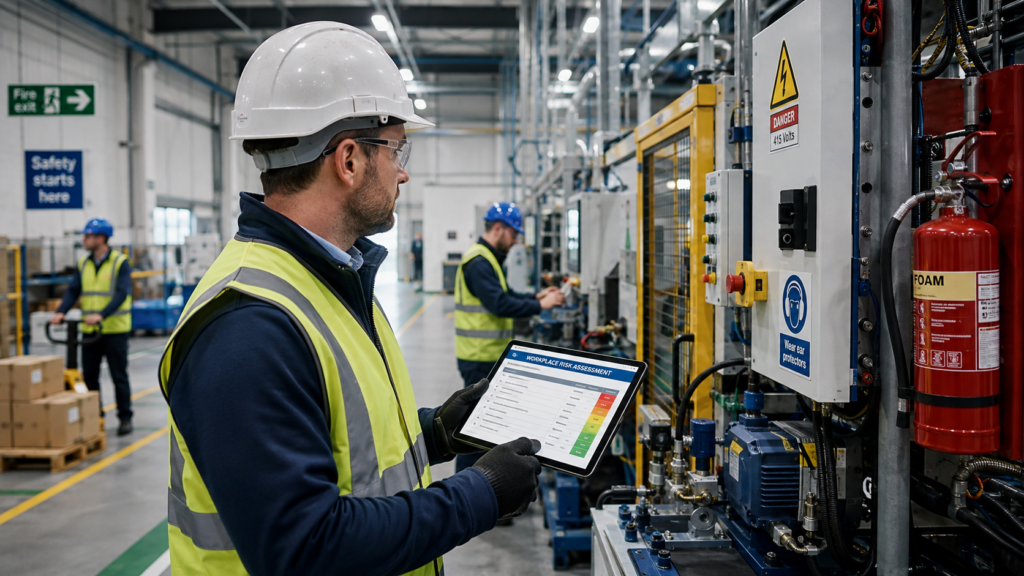
Safety Environment provides professional workplace risk assessment services for UK businesses. A workplace risk assessment is the legally required process of identifying hazards in your workplace, deciding who could be harmed and how, evaluating the level of risk, and putting proportionate controls in place. We carry out tailored assessments — including on-site inspection where appropriate — and provide a documented, practical action plan you can use straight away, not a generic template repurposed for your business.
Request a Workplace Risk Assessment → Speak to a Consultant →
Professional Workplace Risk Assessment Services
Every UK employer has a legal duty to assess the risks their work activities create — for employees, contractors, visitors and members of the public. That duty doesn’t change based on the size of the business, but how it’s best fulfilled often does. A five-person office and a multi-site construction operation both need a risk assessment; they need very different ones.
Safety Environment works with businesses across a range of sizes and sectors to carry out workplace risk assessments that are specific to the workplace being assessed. Depending on what you need, this can mean a full first-time assessment, a review and update of assessments you already hold, or a targeted assessment for a particular activity, area or hazard. In every case, the goal is the same: an accurate, current picture of the risks in your workplace, and clear, achievable recommendations for managing them — not a document written to satisfy a filing requirement and then never looked at again.
Get a Workplace Risk Assessment Quote →
What Is a Workplace Risk Assessment?
In short: a workplace risk assessment identifies hazards in your workplace, works out who could be harmed and how, evaluates how serious each risk is, and sets out the control measures needed to reduce it to an acceptable level. It’s a legal requirement for every UK employer, and it’s the foundation that the rest of your health and safety management is built on.
Beyond that definition, a genuinely useful risk assessment does more than list hazards. It tests whether the controls you already have are actually working — not just whether they’re written down somewhere — and it turns that analysis into a prioritised set of actions, so the organisation knows what to do first, not just what’s theoretically wrong. That distinction is the difference between a risk assessment that sits in a folder and one that actually changes what happens in your workplace.
Why It Matters Beyond Compliance
Framed purely as a legal box to tick, a risk assessment can end up as a formality. Framed as a management tool, it does several things a business genuinely benefits from:
- It surfaces hazards that people who work in the environment every day have stopped noticing.
- It gives management an evidence-based way to decide where to spend limited safety budget and time first.
- It creates a paper trail that protects the business if an incident is ever investigated or an HSE inspection occurs.
- It gives staff a clear, shared understanding of what the risks actually are and what’s expected of them.
- It supports insurance, tendering and client due-diligence requirements, where an up-to-date, professionally produced risk assessment is increasingly expected as standard evidence of a functioning safety management system.
Who Needs a Workplace Risk Assessment?
If you employ staff, or your work could affect other people — contractors, visitors, the public — you need a workplace risk assessment. This is true regardless of business size, and it applies across the full range of UK organisations, from sole traders and small businesses through to larger employers running multiple sites.
The assessment should reflect the risks that genuinely exist in your business, not a generic template copied from a different sector. Two businesses in the same industry can face meaningfully different risks depending on their premises, equipment, staffing levels and working practices — which is one of the most common reasons a downloaded template fails to meet the legal “suitable and sufficient” standard when it’s actually tested against the real workplace.
Small and Medium-Sized Businesses
SMEs carry exactly the same legal duty as larger employers but typically have fewer internal resources — no dedicated health and safety manager, no in-house HSE team — to carry it out and keep it current. This is where professional support tends to add the most practical value: not by replacing the business’s own knowledge of its operations, but by bringing the structured process, objectivity and documentation that’s harder to produce consistently in-house alongside day-to-day operational pressure.
UK Workplace Risk Assessment Legal Requirements
UK health and safety law places responsibility for carrying out risk assessments squarely on the employer. The framework that governs this is:
- The Health and Safety at Work etc. Act 1974 — the primary legislation setting out an employer’s general duty to ensure, so far as is reasonably practicable, the health, safety and welfare of employees, and to protect others affected by the business’s activities.
- The Management of Health and Safety at Work Regulations 1999 — which set out the specific duty (Regulation 3) to carry out a “suitable and sufficient” assessment of risk to employees and others, and the requirement to record significant findings where five or more people are employed.
- HSE guidance — the Health and Safety Executive is the primary UK authority on how to interpret and apply these duties in practice, and remains the reference point for current expectations.
The “Suitable and Sufficient” Standard
A “suitable and sufficient” assessment doesn’t have to cover every theoretical risk in exhaustive detail. HSE guidance is explicit that it should be proportionate to the level of risk involved. What it does have to do is:
- Correctly identify the significant hazards genuinely arising from the work being done
- Correctly identify who could be harmed, including anyone at particular risk
- Result in sensible, proportionate control measures
- Be specific to the actual workplace, activities and people involved
An assessment generic enough that it could apply to almost any workplace in the sector is unlikely to meet this standard if it’s ever tested — whether by an HSE inspector, in an insurance claim, or following an incident.
Recording Your Findings
If your organisation employs five or more people, you’re legally required to record the significant findings of your risk assessment in writing — the hazards identified, who might be affected, the controls already in place, and what further action is needed. Employers with fewer than five staff are not legally required to record findings in writing, though a written record is widely regarded as good practice, since it’s far easier to review, communicate to staff, and produce as evidence than an assessment that exists only informally.
This section provides a general guide to UK workplace risk assessment obligations and is not legal advice. For guidance specific to your circumstances, refer to current HSE guidance or seek independent legal advice.
Why Use a Professional Workplace Risk Assessment Consultant?
Businesses can, and many do, carry out their own risk assessments — there’s no legal requirement to use an external consultant. Professional support tends to be most valuable where workplaces are complex, higher-risk, spread across multiple sites, changing quickly, or where management specifically wants an independent, objective view rather than a self-assessment carried out by people close to the day-to-day work.
What a professional consultant adds in practice:
- A fresh perspective. People who work in an environment every day become used to hazards an outside assessor notices immediately — this is a well-documented limitation of purely internal assessment, not a criticism of internal staff.
- Testing controls, not just listing them. A professional assessment asks not only “what controls exist on paper?” but “are they adequate, and are they actually being followed on the ground?”
- Prioritisation. Instead of a flat list of hazards, risks are ranked so management can direct time and budget at what matters most first, rather than spreading effort thinly.
- Documentation your team can use. Findings are translated into a structured, readable record and action plan — built for the people who’ll actually use it, not written in a way that only a specialist could interpret.
- An ongoing view. A consultant who knows your business over time can help judge when circumstances have genuinely changed enough to warrant a review, rather than relying on a fixed calendar date that doesn’t reflect real risk.
Our Workplace Risk Assessment Process
Our process is built to be thorough without being disruptive to your operations. While every engagement is shaped around the organisation involved, it generally follows these stages:
- Initial consultation. We discuss your business, sites, activities and any existing health and safety documentation, so the assessment is scoped correctly from the start rather than assumed.
- Understanding your work activities. We look at what your people actually do day to day — real tasks, equipment and working environments, not just job titles.
- Workplace inspection, where appropriate. Depending on the nature of your business, this typically includes a site visit to observe conditions and activities directly (see “On-Site Workplace Risk Assessments” below).
- Hazard identification. We systematically identify hazards relevant to your workplace and activities.
- Identifying who may be affected. We consider employees, contractors, visitors and members of the public, and give particular attention to anyone who may be at greater risk.
- Reviewing existing control measures. We assess whether current controls are appropriate, and — critically — whether they’re actually being followed in practice, not just documented.
- Risk evaluation. Each significant hazard is evaluated for likelihood and severity, so risks can be prioritised sensibly rather than treated as equally urgent.
- Recommendations. We set out additional or improved control measures where needed, ordered by priority.
- Documentation. Findings are prepared into a clear, structured written assessment.
- Discussion of findings. We talk the results through with you, so your team understands not just what was found, but why it matters and what to do next.
- Review and update guidance. We advise on appropriate review points based on your specific circumstances, not a generic timeframe.
What Our Workplace Risk Assessment Covers
No single workplace requires every category below — coverage is tailored to your actual premises, activities, equipment and workforce. Depending on your organisation, a workplace risk assessment may consider:
Category | Typical relevance |
|---|---|
Slips, trips and falls | Almost all workplaces |
Manual handling | Warehousing, retail, healthcare, logistics |
Work equipment and machinery | Manufacturing, engineering, construction |
Workplace transport | Warehousing, logistics, construction, industrial sites |
Fire-related risks | All workplaces |
Electrical safety | All workplaces, particularly industrial and older premises |
Hazardous substances (COSHH) | Manufacturing, cleaning, healthcare, laboratories |
Display screen equipment (DSE) and ergonomics | Offices, hybrid/home-working staff |
Working at height | Construction, maintenance, warehousing |
Noise and vibration | Manufacturing, construction, engineering |
Lone working | Field-based roles, out-of-hours work, small teams |
Violence and aggression | Retail, healthcare, hospitality, public-facing roles |
Work-related stress and psychosocial risks | All workplaces |
Emergency arrangements and housekeeping | All workplaces |
Welfare facilities | All workplaces |
Contractors and visitors on site | Construction, industrial, multi-tenant premises |
Vulnerable workers (young workers, new/expectant mothers, disabled workers requiring reasonable adjustments) | Any workplace employing these groups |
Home and hybrid working | Office-based and remote-capable roles |
We identify which of these — and anything else specific to your business — are genuinely relevant to your workplace, rather than working through a fixed checklist regardless of fit.
On-Site Workplace Risk Assessments
An on-site visit is often the most effective way to carry out a workplace risk assessment, because it lets us see actual working conditions rather than relying solely on paperwork or a self-reported description of activities. During an on-site assessment, we typically:
- Observe work activities as they actually happen, not just as documented
- Review the physical layout of the workplace and how people, equipment and materials move through it
- Speak with relevant employees about how tasks are genuinely carried out day to day
- Check whether existing control measures are being followed in practice, not just recorded as being in place
- Identify hazards that may not be obvious from documentation alone
Depending on the size and complexity of your business, a desktop review or remote consultation may be appropriate for parts of the process. For many workplaces — particularly those involving physical activity, equipment, or higher-risk operations — an on-site element adds real, tangible value that a purely paper-based assessment can’t replicate.
Workplace Risk Assessments Across Different Industries
Depending on your workplace and activities, a risk assessment needs to reflect the environment it’s assessing. Our HSE and risk management experience spans construction, manufacturing, heavy industry and renewable energy, alongside broader general and office-based HSE work — giving our consultants a practical grounding in both higher-risk industrial environments and lower-risk commercial settings. Depending on your sector, this can include:
- Construction and industrial sites, where higher-risk activities such as working at height, machinery and workplace transport are often central to the assessment.
- Manufacturing and engineering, where equipment, process safety and COSHH are typically significant.
- Offices and commercial premises, where DSE, ergonomics, fire safety and psychosocial risks tend to be the priority areas.
- Warehousing and logistics, where manual handling, workplace transport and equipment safety are common focus points.
- Multi-site organisations, where consistency of approach and documentation across locations matters as much as the individual assessments.
- Small businesses, where the priority is often a proportionate, clearly explained assessment that doesn’t overwhelm limited internal resources.
Whatever your sector, the underlying approach stays consistent: identify what’s genuinely relevant to your workplace and build the assessment around that, rather than applying a one-size-fits-all template.
What You Receive From Our Workplace Risk Assessment
At the end of the process, you receive a documented workplace risk assessment covering:
- The hazards identified in your workplace
- Who is affected by each hazard, and how
- The control measures already in place
- An evaluation of the resulting risk level
- Recommended additional or improved controls, prioritised by significance
- A practical action plan setting out what needs to happen next
- Guidance on appropriate review points for your specific circumstances
This gives you both the legally significant record — where your organisation is required to keep one — and a genuinely usable working document: something your management team can act on, use to brief staff, and point to as evidence of a proactive approach to health and safety.
Request Your Workplace Risk Assessment →
When Should a Workplace Risk Assessment Be Reviewed?
A risk assessment isn’t a one-off document — it needs to stay current. Rather than a fixed universal timeframe, HSE guidance is clear that assessments should be reviewed whenever circumstances suggest they may no longer be valid. Common triggers include:
- Significant changes to the workplace, layout or premises
- New equipment, substances or processes being introduced
- Changes in staffing, working arrangements or working hours
- An accident, near miss, or newly identified hazard
- Evidence that existing controls aren’t being followed, or aren’t working as intended
- Changes in relevant legislation or authoritative guidance
Even without a specific trigger, periodically checking that an assessment still reflects reality is good practice — particularly for organisations undergoing change, or operating in sectors where conditions shift more frequently than average.
Why Choose Safety Environment?
Safety Environment (Safety Environmental Risk Enterprise Ltd) provides Health, Safety, Environmental and Risk Management consultancy and training, with experience across construction, manufacturing, heavy industry and renewable energy, alongside general HSE and risk management support for businesses of a range of sizes.
- A tailored approach. We work with you to understand your actual workplace and activities, rather than applying a generic template.
- Practical, usable recommendations. Our assessments are written to be understood and acted on by your team, not filed away and forgotten.
- Wider HSE support. Alongside workplace risk assessment, we offer broader HSE and risk management consultancy, safety culture support, and training — including a dedicated Risk Assessment training course for organisations that want to build internal capability alongside outsourced support.
- An independent perspective. As an external consultancy, we bring an objective view of your workplace that can be difficult to achieve when an assessment is carried out entirely in-house.
Speak to Our Team →
Frequently Asked Questions
What is a workplace risk assessment? A workplace risk assessment is the process of identifying hazards in a workplace, deciding who could be harmed and how, evaluating the level of risk, and putting proportionate control measures in place. It’s a legal requirement for all UK employers.
Is a workplace risk assessment a legal requirement in the UK? Yes. Under the Health and Safety at Work etc. Act 1974 and the Management of Health and Safety at Work Regulations 1999, every employer must carry out a “suitable and sufficient” assessment of the risks to employees and others affected by their work.
Who is responsible for carrying out a workplace risk assessment? The employer is legally responsible for ensuring a risk assessment is carried out. It can be done by a competent person within the organisation or by an external health and safety consultant, provided the resulting assessment is suitable and sufficient.
What does a workplace risk assessment cover? Coverage depends on the workplace and activities involved, but commonly includes areas such as slips, trips and falls, manual handling, work equipment, fire safety, hazardous substances, DSE and ergonomics, working at height, and psychosocial risks such as work-related stress.
What are the five steps of a risk assessment? HSE’s recommended approach involves five steps: identify the hazards; decide who might be harmed and how; evaluate the risks and decide on precautions; record your findings and implement them; and review the assessment and update it when necessary.
How often should a workplace risk assessment be reviewed? There’s no single fixed frequency. Assessments should be reviewed whenever there’s a significant change to the workplace, equipment, processes or staffing, after any accident or near miss, or where there’s evidence existing controls aren’t working — as well as periodically as good practice.
Do small businesses need a workplace risk assessment? Yes. The legal duty to assess risk applies to all employers, regardless of size. Businesses with fewer than five employees aren’t legally required to record findings in writing, but the duty to assess risk still applies.
Does a risk assessment need to be written down? If you employ five or more people, you’re legally required to record the significant findings in writing. Below that threshold, a written record isn’t a strict legal requirement, but it’s widely recommended as good practice.
Can a health and safety consultant carry out a workplace risk assessment for my business? Yes. Many businesses use an external health and safety consultant to carry out or support their risk assessments, particularly where workplaces are complex, higher-risk, or where an independent view is valued.
What happens after a workplace risk assessment? You receive a documented assessment setting out the hazards identified, who is affected, existing and recommended controls, and a prioritised action plan. Findings should then be communicated to relevant staff, and recommended actions implemented and tracked.
What is a “suitable and sufficient” risk assessment? It’s the legal standard UK risk assessments must meet — proportionate to the level of risk, specific to the actual work and workplace involved, and capable of identifying the genuinely significant hazards rather than covering every theoretical possibility.
Why should I use a professional workplace risk assessment service? A professional assessment brings an independent, objective perspective, tests whether existing controls are genuinely effective (not just documented), prioritises risks so resources are directed sensibly, and results in clear documentation your team can act on and review over time.
Arrange Your Workplace Risk Assessment
If your business needs a new workplace risk assessment, a review of an existing one, or ongoing HSE support, our team is ready to help. Get in touch to discuss your requirements and take the next step toward a safer, more compliant workplace.
Request a Workplace Risk Assessment → Contact Our Team →